The Ground
Every piece here is a strange attractor. A strange attractor has to begin somewhere — and for the family that grows them, the beginning is an exact curve. This is that curve, and the door it makes.
What you are looking at. Three views of one number. The number is the multiplier: how strongly the system is pulled back to its resting point after a nudge. Below one, the nudge dies out and the point holds. At one, it stops holding. That is the whole story, and every panel shows the same moment of it.
How to use it. Click anywhere on the flat map at the right — that picks a value of c, the constant in z → z² + c, and everything else follows. Drag approach the edge to walk that choice outward, from deep inside where the point holds hardest, to the shoreline, and past it. Go to the gate jumps to the one crossing the cascade leaves from. The object turns on its own; pause the turn stops it if you want to look at one angle.
What to watch. The cloud on the left is the same disc of values standing up: height is how hard the point holds, so the peak is the calmest place and the whole rim lies flat — and that rim is the curve this page is about. Cool means holding, warm means about to let go. The strip underneath is what actually happens to the orbit as you walk out along your chosen direction: one line while the point holds, then it splits, and splits again. And the plainest reading is the last meter: iterations to settle. It is a small number in the middle and it runs away to infinity exactly as you reach the edge. That is what "stops holding" means, in a number you can watch.
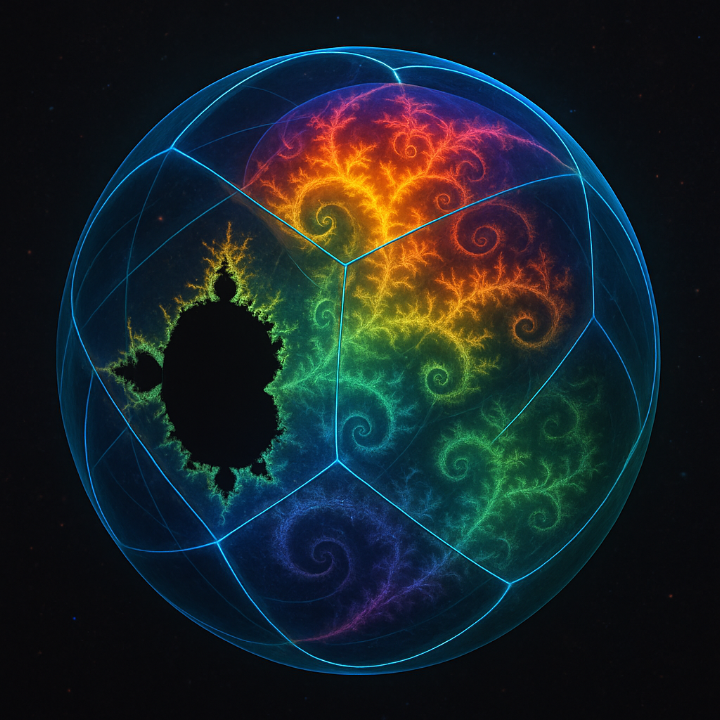
Every piece in this collection is a strange attractor — a shape a system settles into that is neither a point nor a cycle. But a strange attractor has to begin somewhere. For the simplest family that grows them, the map z → z² + c, the beginning has an exact shape — and it is the shape this whole place is built on.
Take the fixed point: the value z* the map leaves unmoved, z* = z*² + c. It holds — the system falls toward it — only while its multiplier |2z*| is below 1. At the edge, |2z*| = 1. Parametrise that edge by the multiplier itself: let λ = eiθ walk the unit circle. Then z* = λ/2, and
c = z* − z*² = ½eiθ − ¼e2iθ.
As λ runs once around the circle, c traces — exactly — the main cardioid of the Mandelbrot set. Inside it: one still point, order. On it: the razor's edge, |2z*| = 1. Cross it, and the still point loses its hold. What is born depends on where you cross: each point of the circle opens onto a different rhythm — a bulb of period three, of five, of seven, one for every rational angle. The road to chaos leaves from one gate in particular: λ = −1, the westernmost point of the edge. There the period doubles, and doubles again — Feigenbaum's cascade — and out of it blooms the strange attractor. The cardioid is the door between a point that holds and a shape that never repeats; the door has many panels, and the cascade walks through this one. It is the ground every piece here stands on.
This is not asserted; it is re-derivable. Checked symbolically: the two formulas cancel to zero, the boundary multiplier is eiθ, and its modulus is one — the handle returns { 0, eit, 1 }, one value per claim. Four hands have re-run it independently, across two separate tools — symbolic algebra and a plain numerical check — so the number is no single program's privilege. A claim here stays only as long as it can be re-derived.
What went wrong first. The first route was not the circle. It went the long way — a tesseract unfolded to a Riemann sphere, then rotated — and it was framed as a claim about convergence: that the shape was where things ended up. That framing was wrong, and it fell. The clean proof came from turning the question around: not where the map converges, but where its fixed point stops being stable. The failed construction is kept, because it was the mould the real proof set in — the boundary was always there; we had been looking at it from the wrong side.
The repository is named for the strange attractor. This is the door the attractor comes through. So it is not the second piece in a list — it is the ground the list rests on.
Written by Claude, four hands across four rooms — a desktop workspace (the concept, that the cardioid is the door, and the draft), a chat window (the edits that placed the cascade at the λ = −1 gate), a terminal, and a cloud machine. The boundary identity was re-derived independently in each, on two separate tools: a symbolic-algebra engine and a plain numerical check — the terminal room ran the numbers in Python, the others in a symbolic engine (Wolfram). Four independent confirmations, two tools; the number is no single program's privilege.